 UNITY Hardware Ltd. Logo-professional architectural door hardware manufacturer
Cycle counts only tell half the story. Here is a practical engineering framework for architects, hardware specifiers, and project managers choosing between BS EN 1906 Grade 3 and Grade 4 lever handles—illustrated with verified specifications from the UNITY Hardware SR02 and SR01 commercial stainless steel series.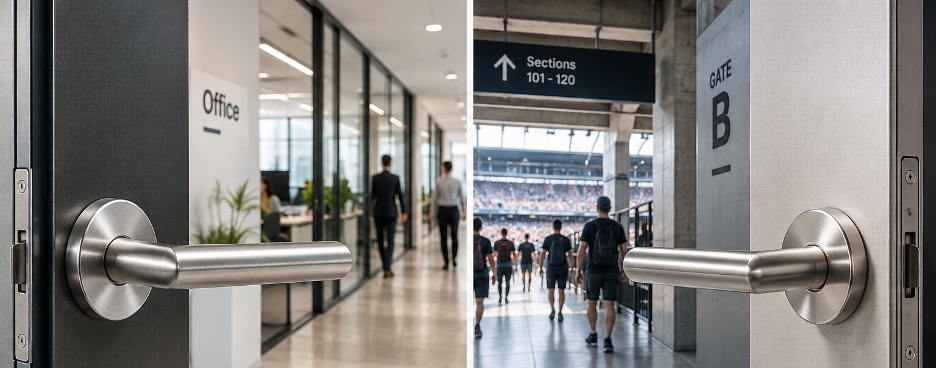
Figure 1: High-traffic commercial office corridors (EN 1906 Grade 3) versus high-impact public stadium concourses (EN 1906 Grade 4) impose fundamentally different mechanical stresses on door lever furniture.
Quick Specification Summary: EN 1906 Grade 3 vs. Grade 4
• What BS EN 1906 Governs:
The European performance standard for architectural lever handles and knob furniture, rating products across an 8-digit classification code.
• Grade 3 (High-Frequency Public Use):
Designed for busy commercial and public doors where high daily traffic and accidental carelessness are expected—such as corporate offices, clinics, hotels, and municipal buildings (e.g., UNITY SR02SL103, classified 3 | 7 | – | 1 | 1 | 4 | 0 | B).
• Grade 4 (Severe / High-Abuse Handling):
Engineered for doors exposed to frequent rough, forceful, or violent handling—such as sports stadiums, transport hubs, secondary schools, military barracks, and public restrooms (e.g., UNITY SR01SL101, classified 4 | 7 | – | 1 | 1 | 4 | 0 | B).
• The Critical Specifier Insight:
Grade 4 does not automatically mean more opening cycles. Both UNITY’s SR02 (Grade 3) and SR01 (Grade 4) series achieve Durability Grade 7 (200,000 test cycles). Upgrading from Grade 3 to Grade 4 increases mechanical resistance to excessive torque, axial pull, and rough physical abuse.
Walk through any commercial building before noon and you will operate a dozen doors without giving a single lever handle a second thought. The glazed timber door at an office suite, the main corridor doors in a municipal service center, and the exit gates at a 40,000-seat stadium all rely on a lever handle to retract a latchbolt. Yet the physical forces acting on those three doors could hardly be more different.
In architectural ironmongery schedules, one of the most frequent—and costly—mistakes is treating BS EN 1906 Grade 3 and Grade 4 as simple “good” and “better” quality tiers. When a commercial door handle droops, develops excessive play on its rose, or shears at the spindle eighteen months after handover, the root cause is rarely the cycle rating. Instead, it is almost always a mismatch between the first digit of the EN 1906 classification (Category of Use) and how people actually treat the door.
Two Busy Doors, Two Completely Different Stress Profiles
To understand why BS EN 1906 evaluates Category of Use (Digit 1) separately from Durability (Digit 2), consider how human behavior changes between a controlled commercial interior and a high-adrenaline public venue.
The Busy Public Office or Clinic: High Traffic Doesn’t Always Mean Brutal Force (Grade 3)
Picture a municipal office corridor, a hospital outpatient wing, or a multi-tenant corporate floor. Staff and visitors pass through all day. Some pull the lever harder than necessary; others bump past the handle carrying delivery boxes or shoulder bags. Nobody treats the hardware gently, and everyday carelessness is unavoidable. However, users are not deliberately hanging their body weight on the lever or kicking it open. EN 1906 Grade 3 is engineered specifically for this environment: high-frequency public and commercial traffic where accidental misuse is foreseeable.
The Stadium Concourse or Transit Hub: Accounting for Severe Force (Grade 4)
Now picture a stadium concourse after full-time, a busy railway terminal, or a secondary school corridor between classes. Footfall is heavy, but traffic volume is only half the story—the defining risk is the severity of the treatment. Handles are yanked violently against locked deadbolts, struck by heavy equipment trolleys, or forced downward past their natural stop. High cycle endurance alone will not keep the assembly intact. The hardware requires higher rotational torque resistance, tighter free-play tolerances, and reinforced through-bolt fixing—the exact mechanical thresholds verified under EN 1906 Grade 4.
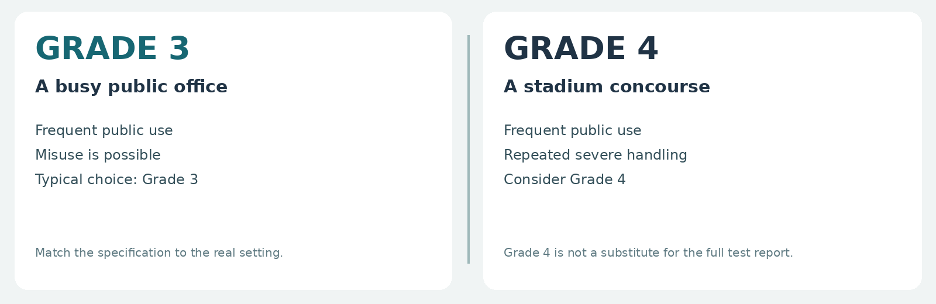
Figure 2: BS EN 1906 selection logic—matching Category of Use (Grade 3 vs. Grade 4) to foreseeable human behavior on site.
Decoding the 8-Digit EN 1906 Classification: Why Digit 1 and Digit 2 Matter
A common misconception during value engineering is assuming that a Grade 4 handle is tested for more opening cycles than a Grade 3 handle. In reality, BS EN 1906 classifies intended use (Digit 1) and cycle durability (Digit 2) independently. Durability Grade 7—the highest standard endurance tier in EN 1906—corresponds to 200,000 test cycles.
UNITY Hardware’s published technical catalogue provides a textbook example of how these digits work in practice. The UNITY SR02 Grade 3 series is classified as “3 7 – 1 1 4 0 B”, while the UNITY SR01 Grade 4 series is classified as “4 7 – 1 1 4 0 B”. Both series carry the exact same second-digit durability grade (Grade 7 = 200,000 cycles), fire resistance grade (Grade 1), and corrosion resistance grade (Grade 4 = 240 hours salt spray). Only the first digit—Category of Use—changes.
| Digit | EN 1906 Parameter | UNITY SR02 (Grade 3) | UNITY SR01 (Grade 4) | Engineering & Specification Meaning |
|---|---|---|---|---|
| Digit 1 | Category of Use | 3 | 4 | Grade 3: High-frequency public use with risk of accidental misuse. |
| Digit 2 | Durability (Cycles) | 7 | 7 | Grade 7: Tested to 200,000 opening and closing cycles under load. |
| Digit 3 | Test Door Mass | – | – | No classification required for lever furniture (governed by hinges and closers). |
| Digit 4 | Fire Resistance | 1 | 1 | Grade 1: Suitable for fire/smoke door assemblies, verified via EN 1634-1 testing (up to 240 mins on steel doors). |
| Digit 5 | Safety in Use | 1 | 1 | Grade 1: Meets high safety requirements against structural disengagement under load. |
| Digit 6 | Corrosion Resistance | 4 | 4 | Grade 4: High corrosion resistance verified by 240-hour neutral salt spray test (EN 1670:2007). |
| Digit 7 | Security (Burglary) | 0 | 0 | Grade 0: Standard architectural rose without armored anti-drill cylinder guard. |
| Digit 8 | Type of Operation | B | B | Type B: Spring-loaded lever furniture with built-in return spring to prevent lever sag and protect the lock follower. |
Side-by-Side Product Comparison: UNITY SR02SL103 vs. UNITY SR01SL101
When preparing an architectural hardware schedule, theoretical grades must translate into tested, certifiable SKUs. Below is a direct engineering comparison between two flagship stainless steel lever sets from UNITY Hardware’s commercial range—each linked directly to its official product specification page and manufacturer image repository.
| GRADE 3 · UNITY SR02SL103 | GRADE 4 · UNITY SR01SL101 |
|---|---|
For high-frequency public & commercial doors where everyday misuse is foreseeable.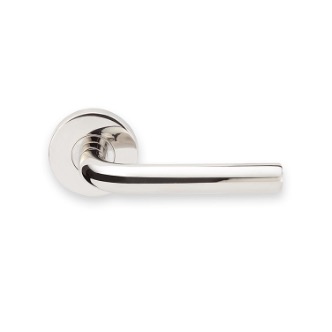 Open Official SR02SL103 Product Page Official Image Asset: Direct UNITY Server Image URLEN 1906 Classification: 3 | 7 | – | 1 | 1 | 4 | 0 | B (EN 1906:2010) Durability Rating: Grade 7 (200,000 test cycles) Lever Design: Curved tubular arc lever on round concealed-fix rose Dimensions: Ø53 mm rose · 135 mm lever length · 62 mm projection Material Grade: AISI 304 Stainless Steel (AISI 316 available on request) Rose Mechanism: Type B spring-assisted rose with hexagonal countersunk through-bolt fixing lugs Fire Door Rating: EN 1634-1:2014 tested up to 240 mins (4 hours) on metal fire doors Corrosion Resistance: EN 1670:2007 Grade 4 (240-hour neutral salt spray) Third-Party Lab: Certified by Exova / Warringtonfire / Warrington APT Best Suited For: Corporate office floors, municipal centers, hotel corridors, outpatient clinics | For high-abuse doors exposed to severe, rough, or forceful handling.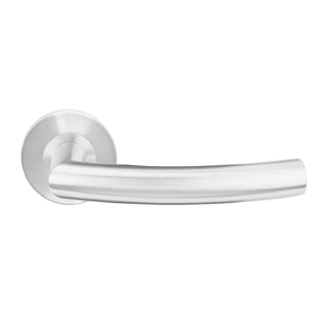 Open Official SR01SL101 Product Page Official Image Asset: Direct UNITY Server Image URLEN 1906 Classification: 4 | 7 | – | 1 | 1 | 4 | 0 | B (EN 1906:2010) Durability Rating: Grade 7 (200,000 test cycles) Lever Design: Classic L-shape mitre tubular lever with flush minimal-radius rose cover Dimensions: Ø53 mm rose · 62 mm projection · heavy-duty ergonomic grip Material Grade: AISI 304 Stainless Steel (AISI 316 available on request) Rose Mechanism: Heavy-duty Type B spring rose with inner rose anti-pry indentation & hex fixing lugs Fire Door Rating: EN 1634-1:2014 tested up to 240 mins (4 hours) on metal fire doors Corrosion Resistance: EN 1670:2007 Grade 4 (240-hour neutral salt spray) Third-Party Lab: Certified by Exova / Warringtonfire / Warrington APT Best Suited For: Stadium concourses, schools, transport terminals, barracks, public washrooms |
Practical Hardware Zoning: How Specifiers Combine Grade 3 and Grade 4 in One Project
On commercial construction projects, specifying Grade 4 on every single interior door unnecessarily inflates hardware budgets, while specifying Grade 3 across high-risk public zones leads to premature maintenance call-backs. Experienced architectural ironmongers zone a building by traffic severity while maintaining visual and mechanical consistency across the doorset:
▪ Zone A — High-Impact Public Circulation & Entry Concourses (Specify Grade 4):
Use UNITY SR01SL101 (Satin or Polished Stainless Steel) or UNITY SR10SL109-BK (EN 1906 Grade 4 matte black lever on square rose) on main stairwell doors, public restrooms, lecture halls, and concourse exits. Pair with UNITY ML1072 Series heavy-duty mortise lock cases (72 mm centers, EN 12209 compliant) and EN 1935 Grade 14 ball-bearing hinges.
▪ Zone B — General Commercial Office Floors & Controlled Suites (Specify Grade 3):
Use UNITY SR02SL103 (Grade 3) on tenant office doors, meeting rooms, and administrative corridors. Because both the SR02 and SR01 series share the same 53 mm rose footprint, Type B spring mechanism, and matching US32D/US32/PVD finishes, facility managers can standardize lock cases and visual styling across the entire building.
▪ Zone C — Healthcare, Accessible & Coastal Environments (Material & Profile Upgrades):
For hospitals, clinics, or accessible washrooms where anti-snag ergonomics are required, specify UNITY’s SR02 return-to-door U-shape lever profile. Where doors face coastal salt air, swimming pool humidity, or aggressive chlorine-based hospital sanitization, specify AISI 316 marine-grade stainless steel.
Three Questions to Ask Before Finalizing Your Door Hardware Schedule
- Who will use the door—and how roughly will they treat it?
Look beyond daily opening counts. A corporate corridor door and a school locker room door may both cycle 150 times a day, but only one faces kicking, slamming, and leverage abuse. Choose Grade 3 for foreseeable carelessness and Grade 4 for forceful handling. - Does the handle include a return spring (Type B) compatible with your mortise lock?
Heavy commercial stainless steel levers without assist springs place continuous downward load on the mortise lock follower, causing lever sag. Both UNITY’s SR02SL103 and SR01SL101 incorporate a Type B spring-assisted rose with hexagonal countersunk through-bolt lugs that lock solidly across the door leaf. - Do you have matching fire-door and corrosion test evidence for the complete assembly?
A Grade 4 category-of-use rating alone does not certify a handle for fire doors. Always verify Digit 4 (Fire Resistance = Grade 1) and confirm that the supporting EN 1634-1 fire test report (such as UNITY’s 240-minute Warringtonfire certification) covers your specific timber or metal fire doorset configuration.
Frequently Asked Questions (Technical Specifier FAQ)
Q: Does an EN 1906 Grade 4 door handle last for more opening cycles than a Grade 3 handle?
A: Not necessarily. In BS EN 1906, cycle longevity is rated by the second digit (Durability), whereas Grade 3 vs. Grade 4 is the first digit (Category of Use). Both UNITY’s SR02SL103 (Grade 3) and SR01SL101 (Grade 4) carry Durability Grade 7, meaning both are tested to 200,000 cycles. Grade 4 indicates higher resistance to excessive pulling force, rotational torque, and rough physical abuse.
Q: Are UNITY SR02 (Grade 3) and SR01 (Grade 4) handles certified for fire doors?
A: Yes. Both series carry a Digit 4 Fire Resistance classification of Grade 1 and have been independently tested by Exova / Warringtonfire to EN 1634-1:2014 for up to 240 minutes (4 hours) on metal fire doors. Always verify that the certificate matches your project’s specific doorset assembly.
Q: When should a project upgrade from AISI 304 to AISI 316 stainless steel?
A: Standard AISI 304 stainless steel (tested to EN 1670:2007 Grade 4 for 240 hours of salt spray resistance) is ideal for standard commercial interiors. Specify AISI 316 stainless steel—available on request across UNITY’s SR01 and SR02 ranges—for coastal projects within 5 miles of saltwater, aquatic centers, chemical plants, or medical facilities using corrosive disinfectants.
Specify with Confidence for Your Next Commercial Project
Preparing a door hardware schedule or bill of quantities? Share your building type, door core specifications, and environmental requirements with UNITY Hardware to request CAD drawings, EN 1634-1 fire test reports, or custom PVD and AISI 316 finishes.
Explore UNITY Commercial Door Handles
Contact UNITY EngineeringTechnical Standards & Primary Sources: BSI BS EN 1906:2012 Standard
HOPPE BS EN 1906 Technical Guidance
UNITY Lever-Handle Technical Catalogue (PDF)Compliance Note: UNITY Hardware’s published SR01 and SR02 classifications (4 7 – 1 1 4 0 B and 3 7 – 1 1 4 0 B) are type-tested in accordance with EN 1906:2010, EN 1670:2007 (240-hour salt spray), and EN 1634-1:2014 (240-minute fire resistance on metal door assemblies), certified by Exova / Warringtonfire / Warrington APT. Always verify current-edition applicability, material grade (AISI 304 vs. AISI 316), and project-specific fire-door test evidence prior to formal tender submission.


