 UNITY Hardware Ltd. Logo-professional architectural door hardware manufacturer
A Beautiful Sample Isn’t Enough: How to Audit and Specify a Door Handle OEM You Can Trust
An engineering-led procurement guide to lo cking down controlled CAD tolerances, SKU-level EN 1906 & EN 1634-1 test evidence, finish limit samples, and export packaging repeatability—benchmarked against UNITY Hardware’s ISO 9001/14001 factories and 9-standard QA lab.
THE SHORT ANSWER
How do you verify a door handle OEM?
Audit the evidence behind production repeatability—not just the showroom sample. Confirm the latest controlled drawings, model-specific test reports, approved finish limits, protective packaging and pre-shipment batch records before releasing mass production.
Why a Beautiful Showroom Sample Is Not Enough
A satin-finished stainless steel lever can feel flawless in a trade-show booth or sample box. The weight sits comfortably in the palm, the rose cover clicks home without play, and the brushed hairline grain looks uniform under office spotlights. Experienced hardware distributors and brand managers know, however, that a prototype only proves a factory has one skilled toolmaker who can hand-fettle a single handle.
What a commercial buyer is actually purchasing is process repeatability across thousands of doorsets. Without written engineering controls, drift creeps in between the second and third production runs: an unmonitored sub-supplier substitutes lower-nickel stainless or zinc die-casting for AISI 304; broached 8 mm follower sockets loosen by 0.15 mm until levers droop; PVD titanium or matte black batches shift shade between furnace loads; or loose M4 through-bolts rub through thin polybags and scar the lever necks before the container reaches port.
Founded in 1998 in Nanjing with two ISO 9001 and ISO 14001 certified manufacturing plants in Wuxi (Jiangsu) and Jiangmen (Guangdong), UNITY Hardware ships 85% of its $10M+ annual output to architectural hardware brands and distributors across the UK, Germany, France, Italy, Spain, Belgium, the United States, the Middle East, and Latin America. The five-stage audit framework below shows how seasoned buyers use controlled drawings, lab verification, finish tolerances, and packaging specs to lock in OEM quality before issuing a purchase order.
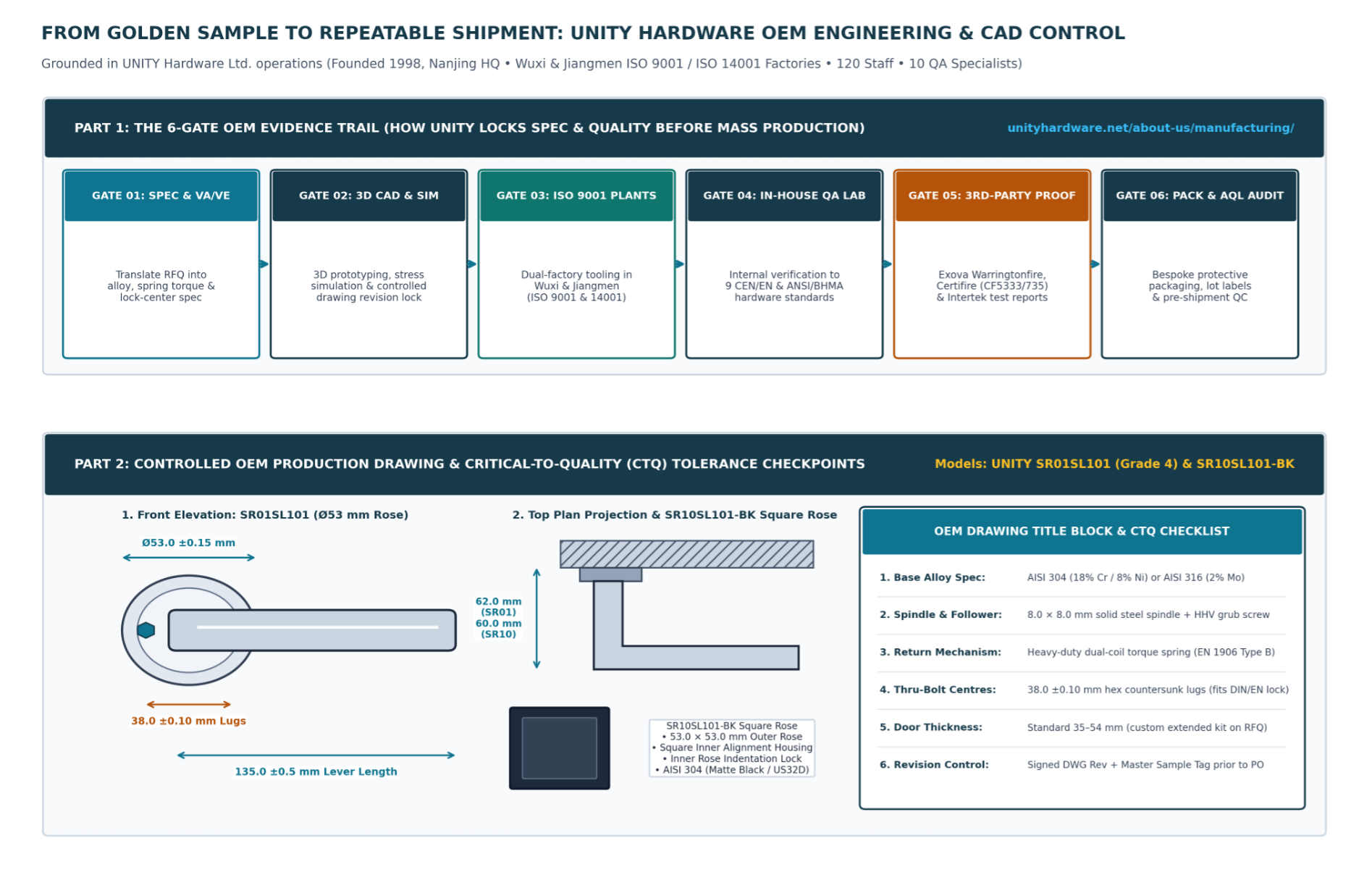
The Controlled Drawing Is Your First Reality Check
An attractive physical sample tells you what a handle looks like; a controlled engineering drawing with a locked revision number tells the CNC shop, the polishing line, the quality-control inspector, and the buyer what must be repeated. Before comparing unit prices across two OEM quotations, place every supplier against the exact same drawing revision and Bill of Materials (BOM).
During UNITY Hardware’s Production Design, Value Engineering (VA/VE), and 3D Prototyping phase, engineers translate a customer’s concept or sample into six locked mechanical parameters:
- Base Metallurgy & Chemical Composition: Specify exact austenitic alloy grades—such as AISI 304 stainless steel (18% Cr, 8% Ni) for standard commercial interiors or AISI 316 (with 2–3% Molybdenum) for coastal and hospital projects—rather than accepting generic “stainless steel” descriptions.
- Lever Envelope & Escutcheon Geometry: Lock lever length, neck clearance, projection, and rose/backplate tolerances—for example, UNITY SR01SL101 specifies a Ø53.0 mm minimal-radius rose, 135.0 mm L-shape lever, and 62.0 mm projection, whereas UNITY SR07SL900 locks a 229 × 44 mm rectangular backplate, 60.5 mm projection, and 185 / 250 / 330 mm U-shape return lever options.
- Anti-Rotation Rose & Thru-Bolt Lug Alignment: Commercial levers fail when outer rose covers spin or thru-bolts miss the mortise lock case. UNITY’s SR01SL101 and SR10SL101-BK drawings lock 38.0 ±0.10 mm hexagonal countersunk fixing lugs (matching standard European DIN/EN mortise locks like UNITY ML107201 and MD107208X) plus an inner rose alignment indentation that prevents cover play.
- Spindle Fit, Return Spring & Door-Thickness Range: Specify whether the assembly is Type B spring-loaded (with dual-coil torque springs to prevent lever sag) or unsprung, confirm the 8.0 × 8.0 mm spindle and grub-screw location, and define the door-thickness range (e.g., standard 35–54 mm vs. extended fire-door packs).
Buyer checkpoint: Treat listed tolerances as illustrative procurement targets until the exact SKU drawing, supplier capabilities and agreed acceptance criteria have been approved.
A Test Claim Needs a Specific SKU Identity and Dual-Layer Verification
Writing “EN 1906 tested” on a catalogue page or quotation is the beginning of technical due diligence, not the end. As documented in the BS EN 1906:2012 standard and industry technical guides such as HOPPE’s BS EN 1906 8-Digit Coding Guide, the 8-digit classification string grades eight separate mechanical attributes—separating Digit 1 Category of Use (Grade 3 high public frequency vs. Grade 4 violent/severe duty) from Digit 2 Durability (Grade 7 = 200,000 cycles), Digit 4 Fire Door Suitability (Grade 1), and Digit 6 Corrosion Resistance (BS EN 1670 Grade 4 = 240-hour neutral salt spray).
To prevent “certificate borrowing”—where a supplier shows a test report for one flagship lever but ships an untested economy rose—UNITY Hardware combines in-house batch verification with independent third-party accreditation:
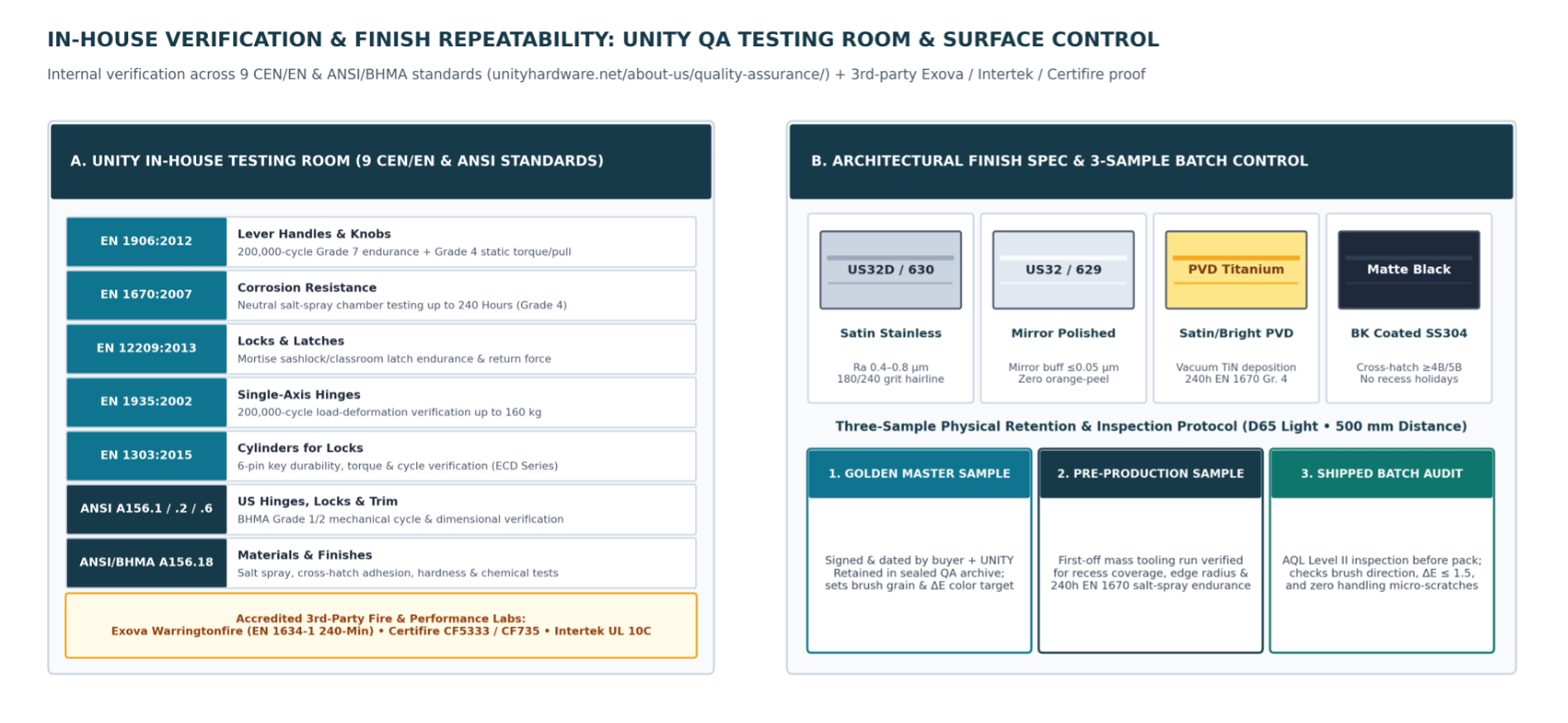
- In-House CEN/EN & ANSI/BHMA Testing Room: Led by a dedicated 10-person Quality Assurance department across its 120-employee operation (UNITY Quality Assurance Testing Room | Official Facility Photo), UNITY built an internal verification laboratory to test prototypes and ongoing production lots across nine international standards: EN 1906:2012 (lever handles), EN 12209:2013 (locks/latches), EN 1935:2002 (single-axis hinges), EN 1303:2015 (cylinders), EN 1670:2007 (corrosion salt-spray chamber), ANSI/BHMA A156.1-2013 (butts/hinges), A156.2-2011 (locks), A156.6-2010 (architectural trim), and A156.18-2012 (materials & finishes).
- Third-Party Accredited Test Reports & Edition Alignment: UNITY partners with Exova Warringtonfire (UK), Certifire (UK), and Intertek Testing Services NA (USA) for formal certification—including BS EN 1906 Grade 3 & Grade 4 lever reports (3 | 7 | – | 1 | 1 | 4 | 0 | B and Grade 4 equivalents), BS EN 1634-1:2014 240-minute fire resistance on metal door assemblies, Certifire CF5333 for Euro mortise locks, and Certifire CF735 / Intertek WH13-18485801 (UL 10C 180-min) for ball-bearing fire hinges. Note that while several product pages cite type-testing under EN 1906:2010, UNITY’s QA laboratory verifies production against EN 1906:2012; buyers should always request the exact model-listed test report and confirm whether their local building authority or CE/UKCA/UL doorset schedule requires additional assembly evidence.
Evidence matters: An EN 1906 use category does not replace a model-specific test report or prove the fire performance of a complete installed doorset. Check the certificate scope, edition and hardware combination.
Finish Quality Must Survive the Second and Third Production Batches
Satin stainless (US32D / 630), mirror polished stainless (US32 / 629), Satin/Bright PVD Titanium, and Matte Black (BK) coatings can make identical stainless castings look like completely different product lines (UNITY Matte Black & PVD Finish Guide). A verbal promise that “the next batch will match” is useless when a distributor has to mix Batch #1 and Batch #2 levers on the same hotel floor.
To eliminate batch-to-batch shade drift and coating peel, enforce a Three-Sample Physical Limit & ANSI/BHMA A156.18 Protocol in your OEM contract:
- Signed Golden Master & Pre-Production Limit Samples: Before mass polishing or PVD/powder coating begins, both buyer and factory sign and date two identical physical master samples (one retained in the buyer’s QA office, one sealed in UNITY’s Wuxi/Jiangmen QA room). For PVD Titanium and Matte Black (SR10SL101-BK), define upper and lower limit swatches (ΔE ≤ 1.5 under a D65 1,000-lux light booth at a 500 mm viewing distance at 45°).
- Grain Roughness & Recess Coverage Inspection: For US32D (630) Satin Stainless, lock the abrasive belt grit (180–240 grit) and surface roughness (Ra 0.4–0.8 μm) so brushed lines run strictly parallel along the lever axis without cross-buffing marks at the neck miter. For Matte Black (SR10SL101-BK / SR11SL243-BK), verify coating coverage inside the inner rose indentation and countersunk lug recesses.
- Adhesion & 240-Hour Corrosion Verification: Test coated and PVD batches in UNITY’s EN 1670:2007 neutral salt-spray chamber (240 hours for Grade 4) and verify cross-hatch tape adhesion (ASTM D3359 ≥ 4B/5B / ANSI/BHMA A156.18-2012) before releasing the lot to packing.
Contract clarity: Limits such as ΔE ≤ 1.5, Ra 0.4–0.8 μm and adhesion ratings are example buyer-defined targets from this guide, not universal pass/fail thresholds for every finish.
Packaging Belongs Inside the Engineering Specification
The most expensive failure in overseas hardware sourcing happens after the product passes final polishing: a heavy steel M4 break-off bolt tears through a thin polybag during a 30-day ocean voyage and gouges a matte black lever, or a warehouse receives mixed finishes in unlabelled cartons. UNITY Hardware provides bespoke material, shape, and size export packaging engineered as part of the product BOM—never as an afterthought.
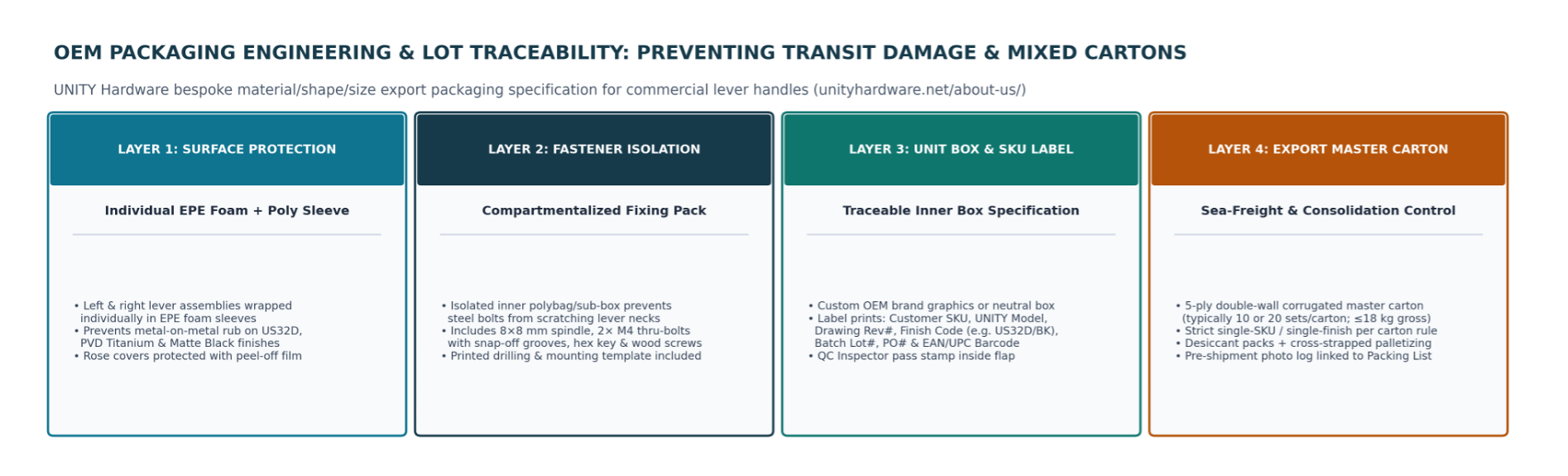
Usable OEM Project Template: Production Part Approval & Batch QC Schedule
To make this guide immediately usable for real procurement projects, the table below provides a field-ready OEM Production Control & Batch QC Schedule modeled on a real commercial production order with UNITY Hardware (combining SR01SL101 Grade 4 Satin Stainless, SR10SL101-BK Matte Black, and SR07SL900 Healthcare Levers). Buyers can copy these exact gates into their Purchase Order Quality Agreement.
| OEM Control Gate | Reference UNITY SKU / Scope | Locked Engineering & Tolerance Target | Verification Method & Standard | Mandatory Supplier Deliverable |
|---|---|---|---|---|
| Gate 01: Drawing & BOM Revision Lock | SR01SL101 (Gr. 4) SR10SL101-BK SR07SL900 Series | Ø53.0 ±0.15 mm rose (or 229×44 plate); 38.0 ±0.10 mm hex lugs; 8.0 +0.05/-0 mm follower; AISI 304 / 316 | 3D CAD simulation + CMM / Vernier first-article dimensional check + OES alloy spectrometer | Signed 2D/3D CAD Drawing (Rev #) + Component BOM + Mill Test Certificate (MTC) |
| Gate 02: Mechanical & Fire Evidence | Lever + ML107201 / MD107208X Lock + HB503530 Hinge | EN 1906: 3|7|-|1|1|4|0|B or Grade 4; 200,000 cycles; 240-min fire integrity on metal door assembly | In-house EN 1906:2012 & EN 12209 cycle rigs + Exova Warringtonfire / Certifire / Intertek reports | Model-named Exova EN 1906 & EN 1634-1 reports + Certifire CF5333 / CF735 certificates |
| Gate 03: Surface Finish & Corrosion Control | US32D (630), US32, PVD Titanium & Matte Black (BK) | US32D Ra 0.4–0.8 μm; BK & PVD ΔE ≤ 1.5 under D65 light at 500 mm; zero recess holidays; 240h salt spray | EN 1670:2007 Grade 4 (240h neutral salt spray) + ANSI/BHMA A156.18 cross-hatch adhesion test | 3 Signed Limit Samples (Master, Pre-Prod, Batch) + Salt-Spray Lab Log |
| Gate 04: Fastener Kit & Export Packing | All OEM Lever & Backplate Sets (35–54 mm doors) | EPE foam sleeve per handle; isolated M4 thru-bolt + 8×8 spindle bag; single-SKU/finish master carton ≤18 kg | Drop/vibration carton check + barcode scan + 100% fastener kit weight verification | Approved Packing Spec Sheet + Pre-Shipment Carton & Label Photo Log |
| Gate 05: Pre-Shipment AQL Batch Audit | Wuxi & Jiangmen ISO 9001 / 14001 Factory Lots | ISO 2859-1 (ANSI/ASQ Z1.4) General Inspection Level II: Critical 0.0, Major 1.0, Minor 2.5 AQL | 10-person UNITY QA team batch pull: spring return torque, spindle fit, finish & label trace | Batch QC Inspection Report + Lot Traceability Certificate prior to vessel loading |
Five proposed procurement gates. Adapt the dimensional targets, sampling levels and certificate requirements to the confirmed SKU and purchase order.
Benchmarking Public Supplier Disclosures & Your 12-Point RFQ Scorecard
Different hardware manufacturers publish different types of technical evidence online. Rather than relying on marketing rankings, procurement teams should understand what each supplier discloses publicly versus what must be requested during the RFQ:
| Manufacturer / Brand | Publicly Verifiable Technical & QA Disclosures | What the Buyer Must Request & Lock in the RFQ / PO |
|---|---|---|
| UNITY Hardware Ltd. (Nanjing / Wuxi / Jiangmen) | Publishes dual ISO 9001 & ISO 14001 plant details (120 staff, 10 QA specialists), a 9-standard CEN/EN & ANSI/BHMA in-house testing lab, SKU-level specs (SR01SL101 Gr. 4, SR07SL900, SR10SL101-BK), and Exova / Certifire (CF5333, CF735) / Intertek accreditations. | Request the controlled CAD drawing revision for your exact SKU, the full Exova Warringtonfire EN 1906 / EN 1634-1 test report, signed physical finish limit samples, and the bespoke export packaging specification. |
| HOPPE Group / ARRONE | Publishes comprehensive BS EN 1906:2012 8-digit coding guidance, DHF best-practice references, surface technology descriptions (SecuSan / Resista), and a dedicated customer portal for Declaration of Performance (DoP) and EPD downloads. | Verify that the specific handle series and rose/backplate combination quoted carries the exact DoP/EN 1906 classification required by your project door schedule rather than relying on brand-wide summaries. |
| dormakaba Group (OGRO / Series 8) | Publishes downloadable Environmental Product Declarations (EPDs to ISO 14025 / EN 15804) and Health Product Declarations (HPDs) for Lever Handles Series 8, four+, and BEST mortise locks to support LEED, BREEAM, and DGNB green building submittals. | Match the specific declaration, EN 1906 certificate, and regional lock-center compatibility (DIN vs. ANSI mortise prep) to the exact model number and finish being procured. |
Six-Category OEM Due-Diligence Scorecard
Score the six documented categories from 0 to 2 points each: 0 = missing evidence; 1 = generic or incomplete; 2 = SKU-specific and verifiable. The source document details six categories (12 possible points), not twelve categories. This is a proposed buyer evaluation aid, not an independently validated industry certification scheme.
| Audit Category | Mandatory Evidence to Request from the OEM | 0 / 1 / 2 Criteria | Max |
|---|---|---|---|
| 1. Controlled CAD & BOM | 2D/3D drawing with revision #, tolerances (±0.10 mm on 38 mm lugs), alloy grade (AISI 304/316), and full component BOM. | 0 = Photo only | 1 = Un-toleranced | 2 = Full Rev-locked CAD + BOM | 2 pts |
| 2. In-House QA Lab | Internal cycle rigs (EN 1906 200k cycles) and salt-spray chamber (EN 1670 240h) for ongoing batch verification. | 0 = Outsourced only | 1 = Basic gauges | 2 = Full CEN/ANSI QA lab | 2 pts |
| 3. 3rd-Party Certificates | Accredited lab reports (Exova Warringtonfire / Certifire / Intertek) naming the exact model family, standard edition, and 8-digit code. | 0 = Unverified claim | 1 = Expired/other SKU | 2 = Valid named report | 2 pts |
| 4. Finish Limit Samples | Signed Golden Master & Pre-Production physical swatches defining grain grit (US32D) or ΔE / adhesion limits (PVD & Matte Black). | 0 = Verbal promise | 1 = Single sample | 2 = Signed 3-sample protocol | 2 pts |
| 5. Packaging & Fasteners | Drawing of inner EPE foam protection, isolated M4 thru-bolt/spindle kit, barcode/lot label, and master carton spec. | 0 = Bulk polybag | 1 = Generic box | 2 = Isolated kit + lot label spec | 2 pts |
| 6. AQL & Change Control | ISO 9001 batch traceability, written ban on unapproved sub-tier material swaps, and pre-shipment AQL Level II report. | 0 = No records | 1 = Final count only | 2 = Full lot trace + AQL report | 2 pts |
Maximum based on the six provided rows: 12 points. Set any procurement approval threshold with your quality team rather than applying the original document’s inconsistent “20/24” rule.
Frequently Asked Questions About Door Handle OEM Sourcing
What is the most effective question to ask a door handle OEM before placing a purchase order?
Ask the supplier: “Please provide the revision-locked CAD drawing, the exact Exova/Intertek EN 1906 & EN 1634-1 test report covering this SKU, the 240-hour EN 1670 salt-spray log, the 3-sample finish retention plan, and the compartmentalized export packaging drawing.” An experienced manufacturer like UNITY Hardware—with ISO 9001 and ISO 14001 certified factories in Wuxi and Jiangmen and a dedicated 10-person QA department—can supply this documentation package upfront, whereas trading intermediaries without engineering control cannot.
Why do some commercial door handle descriptions cite EN 1906:2010 while others cite EN 1906:2012?
Many long-running commercial lever families were originally type-tested and fire-certified under BS EN 1906:2010, while BS EN 1906:2012 is the current consolidated European edition. At UNITY Hardware, published product pages transparently display the original Exova Warringtonfire EN 1906:2010 & EN 1634-1:2014 certificates while the in-house QA testing room verifies ongoing production against EN 1906:2012. Buyers should always verify the exact certificate scope and edition required by their destination market.
How do you prevent Matte Black or PVD Titanium door handles from scratching or changing color across batches?
First, specify solid AISI 304 or AISI 316 stainless steel substrates (such as UNITY SR10SL101-BK) rather than plated zinc alloy. Second, lock a signed physical master sample and verify batch coatings against ANSI/BHMA A156.18-2012 (cross-hatch adhesion) and BS EN 1670:2007 Grade 4 (240-hour neutral salt spray). Third, require EPE foam sleeves on each lever and an isolated inner carton for the steel M4 through-bolts and 8 mm spindle so hardware never collides during ocean freight.
COPY INTO YOUR SUPPLIER RFQ
Request Evidence Before You Commit to Volume
“Please include the revision-controlled 2D/3D drawing and bill of materials for the quoted SKU; relevant model-specific EN 1906 and EN 1634-1 test evidence; finish approval samples and EN 1670 verification; an export-packaging drawing; and the pre-shipment AQL inspection plan.”
Sources & Product Verification
Use these manufacturer and standards pages to review product listings, manufacturing capabilities and test requirements. Ask the supplier for current certificates and controlled drawings for the exact order.
- UNITY manufacturing facilities
- UNITY in-house quality assurance lab
- SR01SL101 Grade 4 handle
- SR10SL101-BK matte black handle
- BSI: BS EN 1906:2012
- UNITY door-handle collection
Publication verification note: The SR10SL101-BK page currently uses conflicting Grade 3/Grade 4 descriptions, so its classification should be confirmed by the exact test certificate before making a definitive grade claim. Factory and certification statements reflect published supplier information and are not substitutes for a project audit.


